15 patterns that reshape how you see.
Each pattern is a physics metaphor you can play with. Drag, toggle, watch. Let your hands teach your intuition.
Pattern Map

Coherence Wins
Coherence beats cleverness.
When instructions contradict, AI models don't pick the "right" one—they hallucinate a compromise. Clear, coherent direction produces reliable outputs. Messy inputs produce messy outputs.
Clear beats messy. Less rework, fewer "what did we decide?" loops.
Contradiction creates cognitive overhead for both humans and machines. When a policy says "move fast" AND "nothing ships without review," teams waste energy resolving the tension every time. AI amplifies this—it will try to satisfy both constraints, producing outputs that do neither well.
The coherence multiplier: One precise decision can collapse many contradictions. "Reviews happen async within 24h" resolves the speed-vs-quality tension once, saving thousands of micro-decisions.
📡 Signals to Watch
- Decision recall accuracy (ask 5 people "what did we decide?")
- Rework rate per project phase
- Number of active "interpretations" per policy
🎛️ Levers You Control
- "Single source of truth + owner + timestamp" for all decisions
- Contradiction audits in prompt libraries
- Explicit priority rankings when values conflict
⚠️ How This Demo Lies
Real contradictions are harder to spot—they hide in assumptions and implicit context, not labeled cards.
Notice: removing contradictions increases speed.
Click statements above to surface contradictions
Notice: one precise decision can collapse many contradictions.
Notice: coherence requires ongoing maintenance, not one-time clarity.
How this shows up at work:
- • Team debates the same decision repeatedly because no one documented it
- • AI outputs vary wildly because prompts contain contradictory instructions
- • New hires get different answers from different people about "how we do things"

The Loop Is the Product
Speed of iteration beats quality of plan.
Feedback reveals what plans assume. A perfect plan tested once loses to a rough sketch tested ten times. Each iteration compounds learning—speed is a multiplier on insight.
Cycle time vs outcome quality correlation proves the point.
The traditional view treats iteration as a cost—each cycle burns time and resources. The modern view treats iteration as the product—each cycle is an investment that yields data you couldn't get any other way.
The iteration dividend: 10× speed doesn't just save time—it changes what's possible to learn. Weekly teams see 4 data points per month. Daily teams see 20. That's not 5× more data—it's a fundamentally different relationship with uncertainty.
📡 Signals to Watch
- Cycle time (idea to deployed test)
- Feedback latency (deploy to first user signal)
- Pivot count per quarter (direction changes from data)
- Plan vs actual drift
🎛️ Levers You Control
- Feature flags (ship without releasing, test in prod)
- Trunk-based development (eliminate branch merge delays)
- Synthetic testing (feedback before real users arrive)
- Automated deployments (remove human bottlenecks)
⚠️ How This Demo Lies
The demo assumes all iterations are equal. Reality: fast iterations on the wrong thing waste cycles. Speed only helps when the feedback signal is real.
Notice: 10× speed doesn't just save time—it changes what's possible to learn.
Notice: Team B doesn't just arrive faster—they have 7× more course corrections.
Notice: speed × signal quality = learning velocity.
How this shows up at work:
- • Team debates feature list for 3 weeks vs. team ships MVP in 3 days
- • 90-day "perfect fit" hiring search vs. 2-week trial contracts
- • Quarterly OKR rewrites vs. weekly "what did we learn" rituals

Bottlenecks Create Gravity Wells
Work accumulates around constraints.
Accelerating non-bottlenecks adds cost, not value. When one stage is slower than others, work piles up in front of it. Speeding up fast stages just moves the pile to the slow stage faster.
Queue length at each pipeline stage tells the truth.
Theory of Constraints isn't new—but AI makes it more visible. When AI accelerates one stage (drafting, coding, analysis), the human stages (review, approval, decision) become the visible bottleneck.
The gravity well effect: Work doesn't just queue—it creates pressure. People rush reviews, skip steps, or find workarounds. The bottleneck shapes behavior across the entire system.
📡 Signals to Watch
- Queue depth at each pipeline stage
- Wait time vs work time ratio
- Utilization by stage (bottleneck at 100%?)
- WIP limit violations
🎛️ Levers You Control
- Subordinate to constraint (don't outpace bottleneck)
- Elevate the constraint (add capacity there only)
- Exploit the constraint (never let it sit idle)
- Find the new constraint (it always moves)
⚠️ How This Demo Lies
The demo shows discrete stages. Reality: constraints shift. Today's bottleneck becomes tomorrow's fast lane when fixed. The constraint is always moving.
Notice: adding more work while the bottleneck exists just makes the pile bigger.
Notice: speeding up fast stages does nothing. Only the constraint matters.
Notice: the constraint is always somewhere. Find it.
How this shows up at work:
- • 10 PRs created daily, 2 reviewers available—work piles up waiting
- • AI drafts contracts in minutes; legal reviews take weeks
- • Features ship fast; learning if they're right takes months

Action Gets Cheap, Coordination Gets Expensive
The cost flip reshapes everything.
AI collapses the cost of doing. Writing, coding, analyzing—all plummet toward near-zero. But coordinating humans? That cost stays fixed—or rises as complexity grows.
Clear interfaces beat perfect alignment.
Traditional organizations optimize for execution efficiency because doing was expensive. But when AI makes doing cheap, the bottleneck shifts to coordination—meetings, approvals, alignment, handoffs.
The coordination tax: Every person added to a decision multiplies communication paths. AI accelerates individual work but can't sit in your meetings.
📡 Signals to Watch
- Meeting hours / execution hours ratio
- Handoff count between team members
- Decision latency (question → resolved answer)
- Rework percentage from misalignment
🎛️ Levers You Control
- Async-first decision processes
- Clear ownership boundaries
- Explicit interfaces between teams
- Smaller, autonomous work units
⚠️ How This Demo Lies
The demo assumes coordination cost is fixed. Reality: bad coordination compounds. One unclear decision creates cascading confusion downstream.
Notice: as action cost drops, coordination becomes the dominant expense.
Notice: AI reduces execution but coordination waste remains—or grows.
AI writes code in hours. But 3 weeks of meetings to decide what to build.
AI generates 50 drafts in minutes. Stakeholder review takes 2 months.
AI runs analysis in seconds. Getting agreement on what the data means takes forever.
Language Is Infrastructure
Your words are now executable.
Natural language is no longer just communication—it's code. The precision of your prompts determines the precision of your outcomes.
Words compile. Choose them like code.
We've spent decades building programming languages to bridge human intent and machine execution. LLMs collapse that gap: language IS the interface. Ambiguity that was "close enough" for humans becomes a bug when parsed by AI.
The linguistic stack: Word choice → interpretation variance → output quality. Each layer of ambiguity multiplies uncertainty in the final result.
📡 Signals to Watch
- Prompt retry rate (how often users rephrase)
- Output variance on repeated prompts
- Time-to-acceptable-output
- Prompt template adoption vs. freeform
🎛️ Levers You Control
- Prompt libraries with validated patterns
- Domain glossaries (reduce interpretation variance)
- Structured inputs vs. freeform text
- Chain-of-thought scaffolding
⚠️ How This Demo Lies
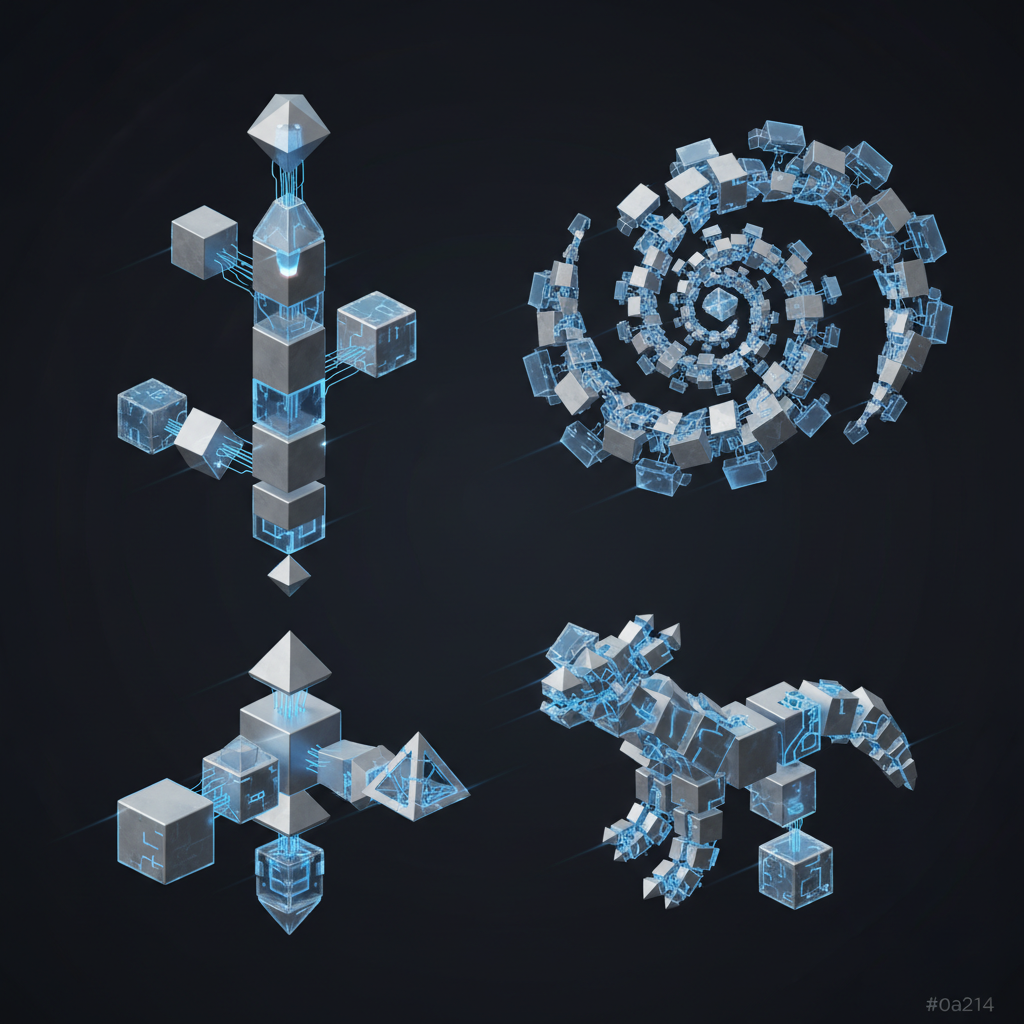
Demo shows discrete word→part mapping. Reality: words have probabilistic meanings that interact. "Build a robot" returns different robots each time. Precision reduces variance but never eliminates it.
Notice: Each word produces exactly one outcome. Your prompts compile.
Notice: Vague prompts create a probability cloud. Precise prompts collapse it.
How "Language Is Infrastructure" Shows Up at Work
"We created prompt templates for common ticket types. Resolution time dropped 40%—not from AI speed, but from forcing precise problem descriptions."
"Our API docs became 10x more valuable when we realized AI was reading them too. We now write for two audiences: humans and machines."
"We built a 'brand vocabulary'—not for humans (they already knew it) but so AI outputs would use our terminology consistently."
Legibility Becomes Power
What AI can read, AI can leverage.
Hidden knowledge is dead knowledge. If it's not in a format AI can parse, it doesn't exist. Make your systems legible or lose to those who do.
Structured > tacit. Queryable > tribal.
James C. Scott wrote about how states make populations "legible" to govern them. AI creates similar dynamics: organizations with structured, queryable knowledge can deploy AI effectively; those with tacit, tribal knowledge cannot.
The legibility paradox: Making knowledge machine-readable makes it easier for AI to leverage—including competitors' AI. The new power play is selective legibility: structured for your systems, opaque to others.
📡 Signals to Watch
- % of decisions that can be audited via data
- Time to answer "why did X happen?"
- Knowledge re-use rate (same info, multiple uses)
- Onboarding time (proxy for tacit knowledge)
🎛️ Levers You Control
- Documentation standards (structured vs. prose)
- Decision logging requirements
- Schema enforcement on data entry
- API-first vs. UI-first system design
⚠️ How This Demo Lies
Demo shows binary legible/hidden. Reality: legibility is a spectrum, and over-structuring kills nuance. Tribal knowledge often carries context that structured data loses. The goal is selective legibility, not total legibility.
Notice: You can only find what's been made findable. The rest is invisible.
Notice: AI leverage is proportional to legibility. Tacit knowledge = AI blind spots.
How "Legibility Becomes Power" Shows Up at Work
"We had an expert who 'just knew' how to handle edge cases. When they left, we lost 8 months—AI couldn't help because the knowledge was never written down."
"The teams with clean schemas in our data warehouse get 10x more AI use cases. The ones with 'flexible' formats can't use AI at all."
"We made our CRM notes structured instead of freeform. AI can now predict which deals will close—but so can any competitor who buys the same AI."

Symbiosis Has Three Modes
Human + AI = parasitism, commensalism, or mutualism.
Not all collaboration is equal. Some setups extract value, some are neutral, some multiply both parties. Design for mutualism or get disrupted.
Default = parasitism. Mutualism requires design.
Biological symbiosis maps cleanly: Parasitism (AI replaces humans, or humans exploit AI labor without learning), Commensalism (one benefits, other unchanged), Mutualism (both evolve and improve together).
The winning pattern is mutualism—humans become better at what AI can't do, while AI handles what humans shouldn't waste time on. This requires intentional design.
📡 Signals to Watch
- Skill growth rate (human learning with AI vs. without)
- Task delegation balance (who decides what AI does)
- Value capture ratio (who benefits from productivity gains)
- Capability evolution (are humans improving or atrophying?)
🎛️ Levers You Control
- Learning requirements (must understand what AI does)
- Skill development time allocation
- AI transparency settings (explain vs. just do)
- Human override frequency and authority
⚠️ How This Demo Lies
Demo shows clean categories. Reality: most relationships are mixed—parasitic in some ways, mutualistic in others. The question isn't "which mode" but "what's the net effect over time."
Notice: The waves show energy flow. Only mutualism amplifies both.
Notice: Time reveals the mode. Parasitism shows early; mutualism compounds.
How "Symbiosis Has Three Modes" Shows Up at Work
"I used Copilot like autocomplete for a year—my coding got faster but I stopped learning. Parasitism. Now I make it explain patterns first, then generate. Much slower, but I'm actually growing."
"We automated tier-1 support. Reps handle harder cases now—their skills jumped. But we didn't raise their pay. Commensalism for workers, mutualism for the company."
"I treat AI as a sparring partner, not an assistant. Every analysis I have it critique, every critique I push back on. Takes longer but my thinking is sharper than ever. Mutualism."

Identity Is a Gravity Well
"I am X" resists "I should try Y."
The strongest barrier to AI adoption isn't capability—it's identity. "I'm a writer" resists "let AI draft." Identity must evolve or shatter.
Identity = inertia. Meta-identity = adaptability.
Identity creates cognitive gravity: the stronger your self-concept around a skill, the harder it is to delegate that skill to AI.
"I am a coder" makes you resist AI code gen; "I solve problems using any tool" makes you embrace it. The transition isn't about learning new tools—it's about reconstructing identity around meta-skills that remain human.
📡 Signals to Watch
- Emotional resistance to specific AI tools
- Phrases like "that's not really X-ing"
- Time to try new AI capabilities (longer = stronger identity)
- Defense of process over outcome
🎛️ Levers You Control
- Role descriptions (skill-based vs. outcome-based)
- Success metrics (method-agnostic vs. method-specific)
- Team narratives about what "good" looks like
- Permission to experiment without identity threat
⚠️ How This Demo Lies
Demo shows identity as a single spring. Reality: people have multiple overlapping identities. Sometimes AI threatens one while serving another. The negotiation is internal and complex.
Notice: The further you pull, the harder it snaps back. That's identity.
Notice: Same person, different framing = different AI relationship.
How "Identity Is a Gravity Well" Shows Up at Work
"I fought Copilot for months. Finally realized: I'm not 'a coder'—I'm someone who solves business problems. Now I use AI for boilerplate so I can focus on architecture. Threat became enabler."
"'I'm a writer' made AI feel like cheating. 'I craft messaging that moves people' made AI a research assistant. Same job, different identity, completely different tool relationship."
"My best engineers adopted AI fastest. They didn't identify as 'coders'—they identified as 'problem-solvers who happen to code.' The identity escape hatch matters."

Entropy Debt Compounds
AI-generated mess grows faster than human-generated mess.
AI accelerates production—including the production of cruft. Without deliberate entropy reduction, systems collapse under their own weight.
Generate fast. Cull faster.
Technical debt is a subset of entropy debt. When AI can generate code 10x faster, it also generates inconsistency, duplication, and architectural drift 10x faster.
The entropy multiplier: The solution isn't to slow generation—it's to build entropy-reducing loops into the system. Codebase growth rate, refactoring frequency, and search time inflation are your leading indicators.
📡 Signals to Watch
- Time-to-find for existing code increasing
- Duplicate implementations discovered weekly
- New hires take longer to onboard
- "Just rewrote it" becoming common
🎛️ Levers You Control
- Automated refactoring frequency
- Delete-to-create ratio targets
- Mandatory code review friction
- Architecture decision records (ADRs)
⚠️ How This Demo Lies
Real entropy is invisible until cascade failure. The meter shows gradual rise; reality shows sudden collapse.
Notice: Entropy grows automatically. You can only slow it, not stop it.
Notice: AI-augmented teams hit collapse faster—unless they cull proportionally.
The meeting: "AI is making us so much more productive! Look at all this code!"
The reality: 50 new utility functions, 30 duplicates of existing ones. Sprint velocity up, but 40% of PRs refactor last sprint's AI output.
The pattern: Cheap generation without attention creates technical debt at machine speed. Search becomes archaeology.
The move: Track delete-to-create ratio. Healthy systems delete 1 line for every 3 added. AI-heavy teams often hit 1:20. Attention is the scarce resource—allocate it wisely.

Persuasion Has Gravity
Beliefs attract evidence that confirms them.
AI can generate infinite supporting evidence for any position. The scarce resource isn't persuasion—it's discernment.
Infinite content, finite discernment.
Confirmation bias meets infinite content generation. AI can produce compelling arguments for any position—true or false. This creates belief gravity wells.
The discernment deficit: Once someone holds a position, AI can reinforce it indefinitely. Critical thinking becomes the immune system. Source diversity and contra-argument seeking are your leading indicators.
📡 Signals to Watch
- AI-generated content dominates research feeds
- Team rarely encounters opposing viewpoints
- Decisions feel "obviously right" with no pushback
- Echo chambers form around AI recommendations
🎛️ Levers You Control
- Mandatory devil's advocate prompts
- Source diversity requirements
- Pre-mortem exercises on decisions
- Red team AI with opposing instructions
⚠️ How This Demo Lies
Real belief gravity is invisible. You don't see the evidence that never reaches you.
Notice: Evidence that confirms gets pulled in. Evidence that contradicts drifts away.
Notice: In confirmation mode, you only see what already agrees with you.
The meeting: "Let's get AI to summarize the competitive landscape."
The reality: AI produces a confident summary that confirms what leadership already believes, filtering out disconfirming evidence.
The pattern: AI becomes a confirmation amplifier, making existing biases feel more justified.
The move: Require adversarial prompts: "Make the strongest case AGAINST our strategy." Compare outputs.
Prompt Is Policy
Your system prompt is your constitution.
The rules you embed in AI instructions become the laws of your system. Prompt engineering is governance engineering.
Prompts execute with zero discretion.
Constitutional law, not guidelines: Unlike human policy—which gets interpreted, negotiated, sometimes ignored—prompt-policy executes. Every time. No exceptions. No forgetting.
Governance precision becomes critical: Ambiguity in prompts creates unpredictable behavior at scale. Vague policies create vague boundaries.
Policy conflicts in multi-agent systems reveal this clearly: AI behaving inconsistently signals prompt ambiguity, edge cases signal policy gaps, and user workarounds signal policy-behavior mismatch.
📡 Signals to Watch
- Policy contradiction rate across responses
- Override frequency in edge cases
- Ambiguous case count growing over time
🎛️ Levers You Control
- Policy priority ordering (what wins when they conflict)
- Conflict resolution rules (explicit fallbacks)
- Default behaviors (when policies don't apply)
⚠️ How This Demo Lies
Real policy conflicts are emergent and context-dependent. This shows deterministic conflicts only.
The meeting: "We need an AI policy for the company."
The reality: The policy document gets filed away while the actual prompts in production systems define real behavior.
The pattern: Prompt instructions are the actual policy. Company guidelines only matter if encoded into prompts.
The move: Treat prompt engineering as governance engineering. Version control prompts. Review them like code and policy combined.

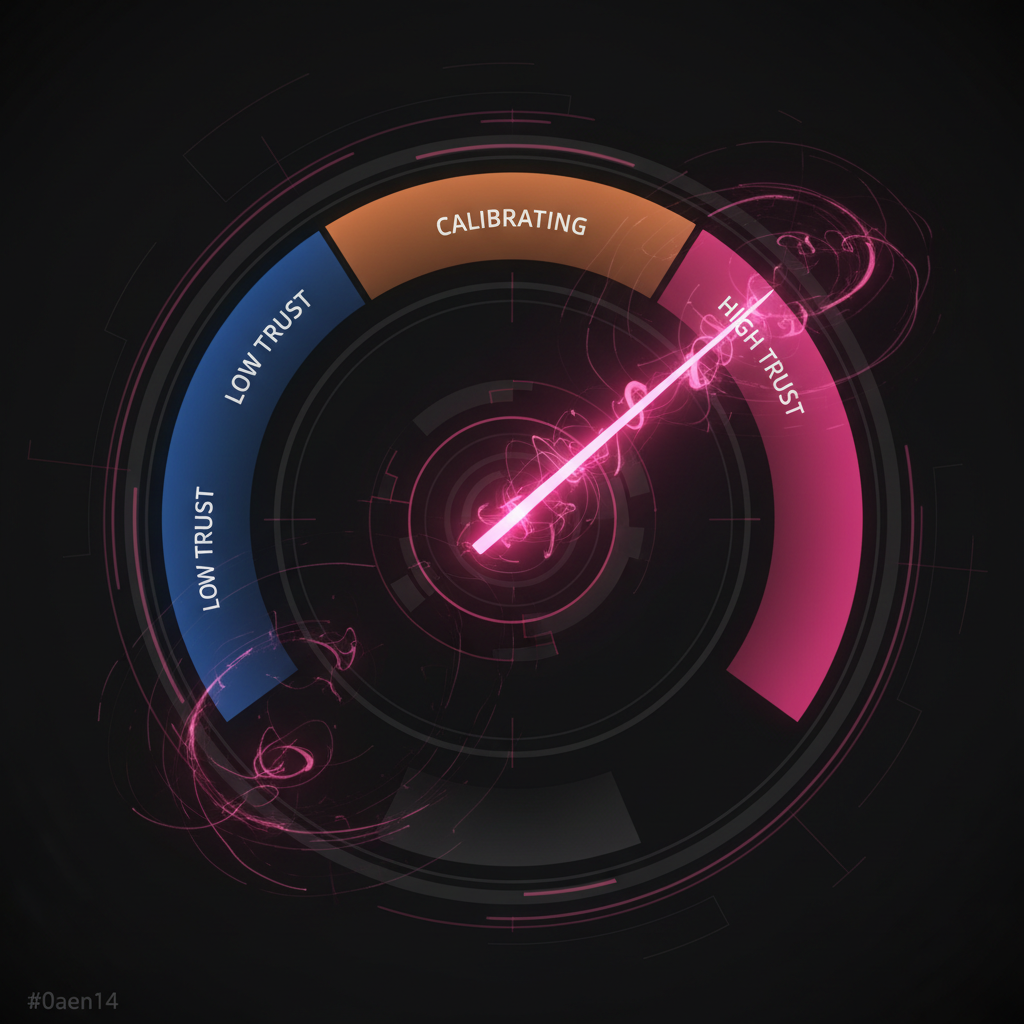
Fear Is a Systems Variable
Too little fear = reckless. Too much = paralyzed.
Fear of AI is a dial, not a switch. Calibrate it: enough to be careful, not so much you freeze. The optimal setting changes as you learn.
Optimal fear is context-dependent.
Yerkes-Dodson curve: Too little fear leads to careless mistakes. Too much leads to paralysis. Moderate arousal optimizes performance.
Fear as feedback signal: The healthy response isn't "don't be afraid" or "be very afraid"—it's "be appropriately afraid, and update as you learn." Fear should update with evidence, not lock in.
Team velocity correlates with fear levels: Excessive review cycles signal fear too high. Skipped testing and rushed deploys signal fear too low. Fear unchanging over months signals the system isn't updating.
📡 Signals to Watch
- Time to first AI experiment (how long before trying)
- Review cycle length (excessive = too fearful)
- Rollback frequency (too many or too few)
🎛️ Levers You Control
- Sandbox environments (lower stakes for experimentation)
- Incident post-mortems (learn without blame)
- Success story sharing (calibrate toward action)
⚠️ How This Demo Lies
Real fear isn't a single dial. It varies by domain, stakes, and individual.
The meeting: "We need to slow down on AI adoption until we're sure it's safe."
The reality: Fear freezes the team while competitors learn and iterate. Neither extreme works.
The pattern: Fear should be calibrated by domain. Sandbox experiments should feel safe. Production deploys should feel appropriately cautious.
The move: Create graduated environments. Update fear based on actual outcomes, not hypotheticals.

Security Becomes AI vs AI
Attack and defense both accelerate.
AI writes exploits. AI writes patches. The arms race now runs at machine speed. Human security teams become orchestrators, not combatants.
Speed determines who wins, not skill.
New equilibrium: The cat-and-mouse game of security enters a new phase. AI can find vulnerabilities faster than humans, but AI can also patch them faster. The balance shifts from "who has better humans" to "who has better AI + better AI governance."
Humans become meta-players: Security experts now set objectives, define constraints, and evaluate AI security agents. The fight moves up a level of abstraction. Humans move from fighters to referees.
Verified by security incident response times: Organizations using AI-assisted defense show dramatic reductions in mean time to patch—but so do AI-assisted attackers.
📡 Signals to Watch
- Vulnerability discovery rate (AI vs human baseline)
- Mean time to patch (automated vs manual)
- False positive rates in AI detection systems
- Novel attack surface emergence rate
🎛️ Levers You Control
- Detection sensitivity thresholds
- Automated response policies
- Human-in-the-loop escalation rules
- Attack simulation frequency
⚠️ How This Demo Lies
Real security is asymmetric: attackers need one success, defenders need 100% coverage. Demo shows balanced battles; reality favors whoever has the faster feedback loop.
The meeting: "Let's use AI to automate our security testing."
The reality: You deploy AI-powered security tools that scan faster and find more vulnerabilities than your human team ever could. Meanwhile, attackers deploy their own AI that probes your defenses faster than you can patch. Each improvement in your detection triggers an improvement in their evasion.
The pattern: Security becomes an AI arms race where both sides have access to the same fundamental capabilities. The advantage goes to whoever adapts faster—and attackers, unconstrained by compliance and change control, often move first.
The move: Build security posture for a world where AI amplifies both offense and defense. Assume adversaries have the same tools. Focus on fundamentals that can't be automated away—minimizing attack surface, defense in depth, and incident response speed.

Values Are Constraints, Not Posters
If AI can violate it, it's not really a value.
Values posted on walls do nothing. Values embedded as constraints in AI systems are enforced every time. Make your values executable.
Values without enforcement are wishes.
Corporate values often become aspirational fiction: Nice words that collapse under pressure. AI forces honesty: if a value isn't encoded as a constraint, the system won't follow it.
"We value customer privacy" means nothing unless the AI literally cannot access customer data without authorization. The statement becomes meaningless if violations are technically possible.
Values become architecture, ethics becomes engineering: In AI systems, what you value is what you enforce. Everything else is marketing copy.
📡 Signals to Watch
- Violation attempts blocked vs. allowed
- Override request frequency
- Time from stated value → hard constraint
- Gap between stated and enforced values
🎛️ Levers You Control
- Enforcement level (poster/soft/hard)
- Override approval chain
- Audit trail depth
- Constraint bypass timeout
⚠️ How This Demo Lies
Real constraints require infrastructure changes. Edge cases are always more complex than binary choices. Political cost of hard constraints isn't shown. "Override" often means "call someone senior" in practice.
The meeting: "We value customer privacy in everything we do."
The reality: Your AI assistant has full access to customer data with no access controls. The value statement is on the wall and in the employee handbook, but nothing in the system enforces it.
The pattern: Values without enforcement are marketing copy. AI exposes this gap ruthlessly—systems either enforce constraints or they don't. There's no middle ground.
The move: Audit your stated values against what your AI systems can actually do. Move from poster values (written policy) to soft constraints (warning + logging) to hard constraints (blocked actions). Make ethics into engineering.

Identity Stress Is the Next Big Adoption Wall
Skills can change. Self-concept struggles.
The hardest part of AI adoption isn't learning new tools—it's letting go of who you thought you were. Identity stress, not skill gaps, blocks progress.
Train skills AND tend identity.
AI creates an existential adoption barrier: We've solved technical adoption barriers many times. But when a tool can do what you trained your whole life to do, the question "what am I for?" becomes urgent.
Identity transitions require support, not just training: Organizations that acknowledge and support identity transition—not just skill transition—will capture the talent that others lose to fear and denial.
Resistance often masks grief: The person fighting hardest against AI may be mourning a future they spent decades building toward. Meet that grief with acknowledgment, not arguments.
📡 Signals to Watch
- Stage distribution across team
- Time stuck in each stage
- Regression events (backsliding)
- "What am I for?" questions frequency
🎛️ Levers You Control
- Acknowledgment intensity
- Reframing narrative choice
- Transition pace expectations
- Peer support vs. management support
⚠️ How This Demo Lies
Real transitions take months or years, not clicks. People cycle through stages non-linearly. Scripts sound hollow without genuine care. Some never integrate—and that's data too.
"Your 20 years of experience aren't replaceable."
"Think of AI as a power tool that makes your expertise reach further."
"Now you can focus on the strategic decisions only you can make."
The meeting: "Everyone needs to learn these AI tools by next quarter."
The reality: Your top performers resist. Not because they can't learn—because learning threatens who they are.
The pattern: Identity stress shows up as "concerns about quality" or "questions about the approach." The real fear is rarely spoken.
The move: Create safe spaces to process identity transition. Acknowledge that expertise still matters. Frame AI as amplifier, not replacement. Measure psychological safety alongside skill adoption.
Intuition rewired. Now go build.
These patterns aren't rules—they're lenses. Use them to see what others miss.